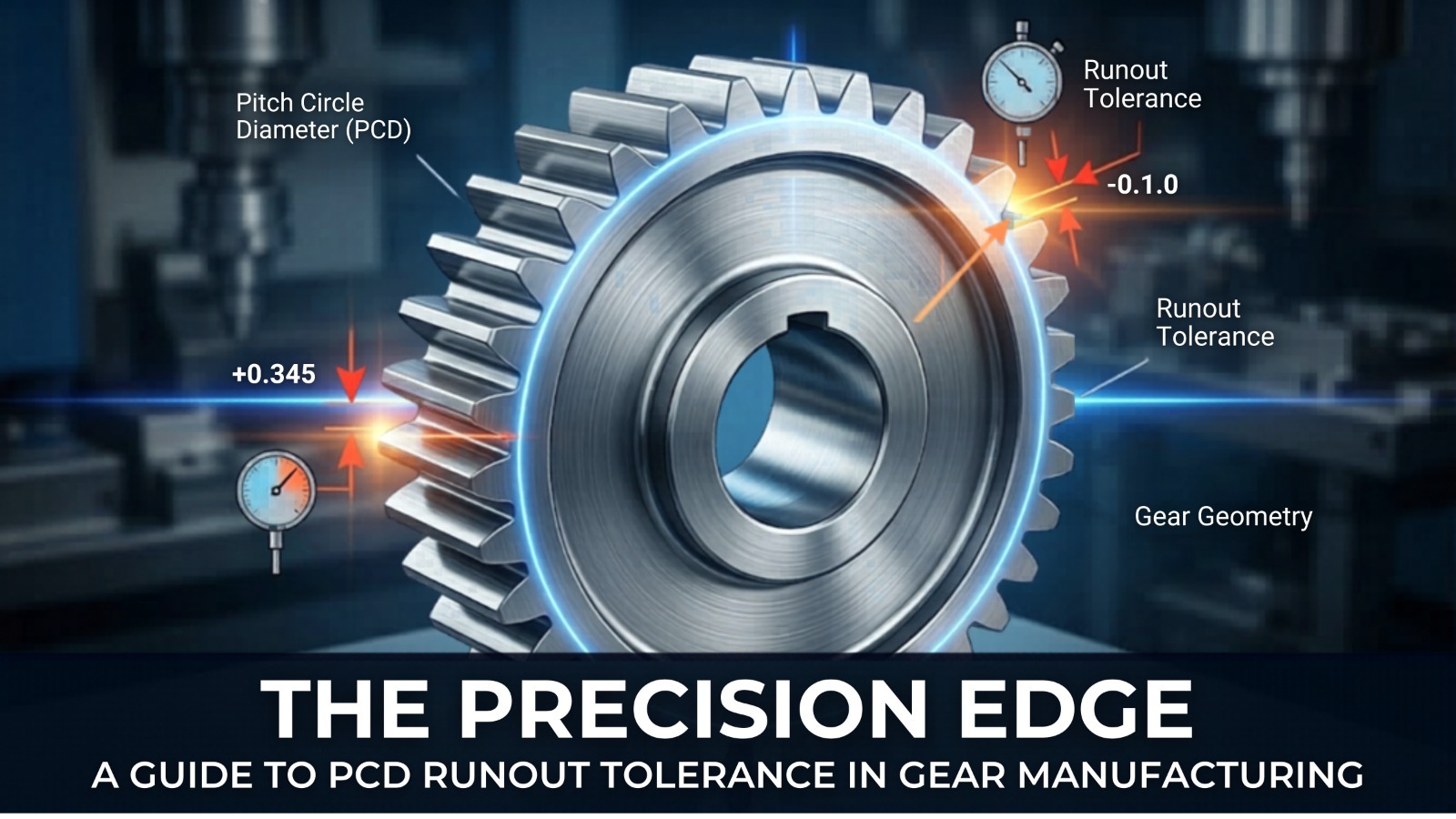
In gear manufacturing, precision isn’t just a metric—it’s the difference between a high-performance machine and a costly mechanical failure. Among the various parameters tracked during inspection, PCD (Pitch Circle Diameter) Runout is one of the most critical indicators of gear quality.
Whether you are designing for automotive drivetrains or heavy industrial machinery, mastering runout tolerances is essential for operational longevity & noiseless operation.
What is PCD Runout?
PCD Runout measures the radial variation of a gear’s pitch circle relative to its axis of rotation or with respect to bearing datums in the assembly. In practical terms, it is known as the “wobble” of the gear. When the pitch circle is not perfectly concentric with the bore or shaft, the gear teeth do not mesh at a consistent depth as they rotate.
Common Causes of Runout:
- Setup Errors: Improper mounting or alignment during the machining process.
- Geometry Issues: Non-concentricity between the gear’s bore and its outer diameter.
- Metallurgical Shifts: Distortion or “warping” caused by uneven cooling during heat treatment.
Why Tolerance Limits are Non-Negotiable
Ignoring runout doesn’t just result in a noisy machine; it creates a cascade of mechanical issues:
- Uneven Load Distribution: Certain teeth take more stress than others, leading to premature pitting or breakage.
- Transmission Errors: Fluctuations in angular velocity that can ruin the synchronization of high-speed systems.
- Vibration & Noise: Excessive runout is a primary driver of high-frequency gear whine.
- Breakage: In extreme cases and high load conditions it can also lead to breakage and severe damage.
Defining “Acceptable” Runout
There is no “universal” tolerance; limits are dictated by the gear’s application and required quality grade (such as ISO 1328, DIN or AGMA standards).
Modern Inspection: Moving Beyond the Dial Indicator
While simple fixtures coupled with manual dial indicators are useful for quick checks, modern quality control relies on Composite Inspection or Automated Inspection with ball to ensure 100% accuracy.
- Using specialized Gear Rolling Testers, manufacturers can simulate actual assembly conditions. By rolling a work gear against a high-precision master gear, systems like the Roll Smart or GearMate can instantly detect:
- PCD Runout
- Total Composite Error (TCE)
- Tooth-to-Tooth Error (TTE)
Automated inspection with ball can help bring standard room inspection on to the shop floor enabling 100% inspection in place of sample inspection. This also enables quantified inspection with data recording and SPC analysis to better control the manufacturing process too!
Pro Tip: Automated testers allow for 100% data capturing, which is vital for providing “zero rejection” assurance to customers in the automotive and aerospace sectors.
5 Strategies to Minimize Runout
- Optimize Fixturing: Use high-quality mandrels and precision chucks to minimize “play” during cutting.
- Control the Bore: Ensure the reference bore is finished to a tight tolerance before the teeth are cut.
- Post-Heat Treat Finishing: Use gear grinding or honing to correct distortions that occur during hardening.
- Regular Calibration: Ensure your measurement equipment is calibrated to traceable standards.
- Environmental Stability: Maintain a temperature-controlled inspection room to prevent thermal expansion from skewing micron-level readings.
Conclusion
PCD runout might seem like a small detail, but in precision engineering, it is often the smallest deviations that have the largest impact. By adhering to strict ISO/AGMA standards and utilizing advanced rolling testers, you can ensure your gears deliver smooth, quiet, and reliable performance for years to come.
Are you looking to find a solution for specific runout challenges?
Call 98220 32062 to discuss.